How Do You Price a Fair Oaks Home When the Comps Don't Match?
Fair Oaks | Sellers
How Do You Price a Fair Oaks Home When the Comps Don't Match?
By Lauren Pierce, Realtor® | Windermere Signature Properties
Last updated: October 4, 2026
At a Glance
Fair Oaks homes can be harder to price than homes in more uniform subdivisions because style, age, lot size, topography, condition, and street setting may change within a few blocks. A reliable price should begin with the closest recent sales, then account for the differences buyers will actually notice—not simply accept one automated estimate or the highest nearby sale.

Why are Fair Oaks homes harder to compare?
Comps means comparable sales—recently sold homes similar to yours. In Fair Oaks, two homes can share a ZIP code and little else.
That is part of the appeal. Sacramento County describes the community as a mix of suburban and semi-rural neighborhoods with rolling hills, native oaks, and an established village center. The county's Fair Oaks Village preservation standards go further, noting the area's eclectic mix of home styles, sizes, ages, and values, along with narrow streets, mature trees, and limited curbs, gutters, sidewalks, and streetlights.
A tidy algorithm likes tidy neighborhoods. Fair Oaks declines to cooperate.
One nearby sale may be a largely original ranch on a level lot. Another may be a renovated cottage near the Village. A third may be a larger custom home with a pool, extensive landscaping, or a location closer to the American River. They are all relevant, but they are not interchangeable.
What does the current Fair Oaks market say?
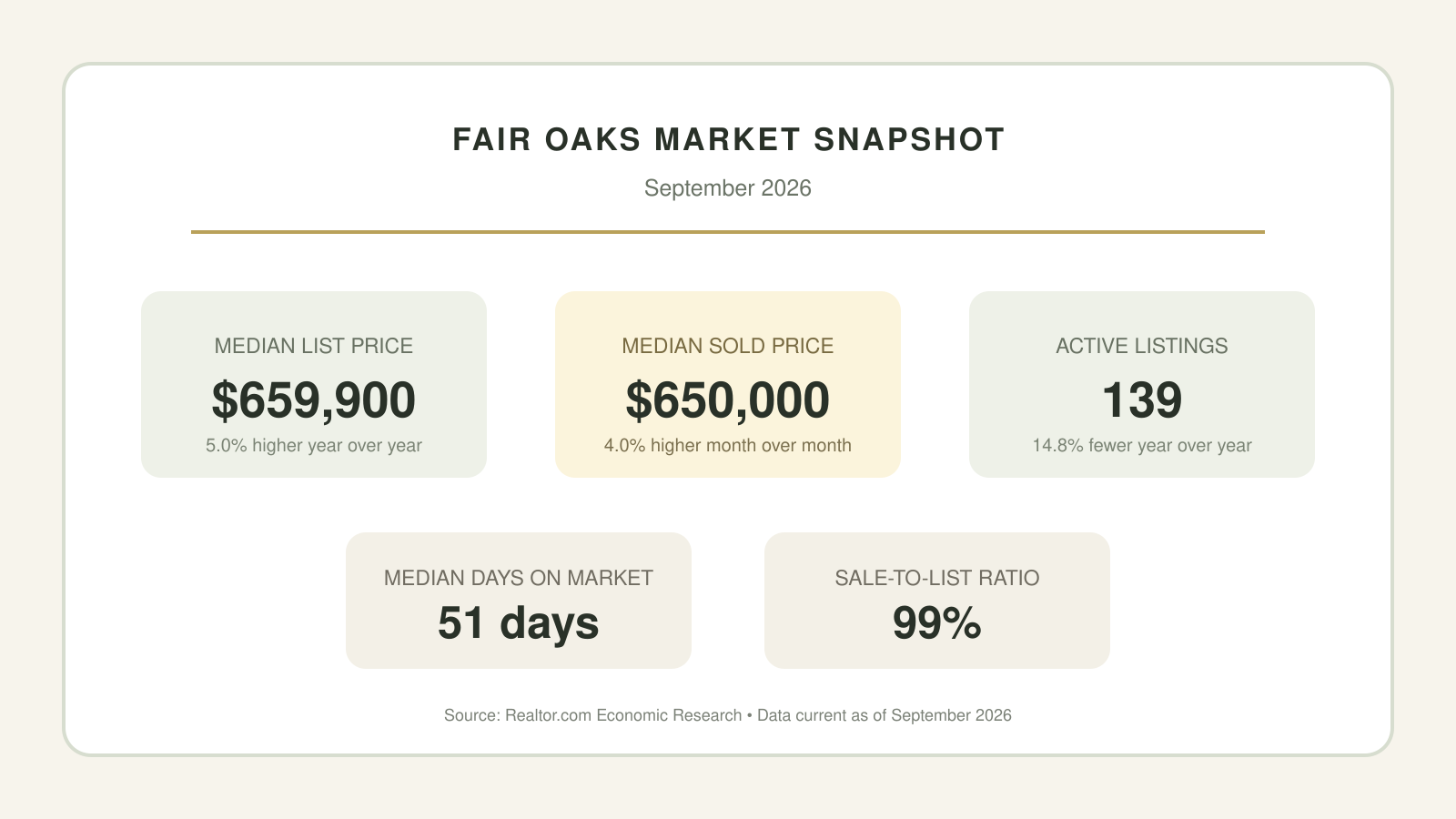
Realtor.com's September 2026 data shows a median listing price of $659,900 and a median sold price of $650,000. There were 139 active listings, homes spent a median 51 days on the market, and the average sale-to-list ratio was 99%.
Those numbers suggest a competitive market, but they do not establish the value of a particular property. A citywide median blends remodeled and dated homes, quiet interior streets and busier roads, smaller lots and more generous ones. It is a useful compass, not a house number.
The 51-day median also deserves context. Well-positioned homes can move faster, while properties that are unusual, over-improved for their immediate area, or initially priced beyond buyer expectations can take longer. The first few weeks still matter: that is when a new listing has the strongest chance to capture buyers who have already been watching the market.
Which differences matter most when selecting comparable sales?
I start with location and recency, then work outward carefully. The most useful comparison is rarely the home that merely has the closest square footage.
- Micro-location. Buyers may respond differently to a quiet lane, a busier route, proximity to the Village, river access, commute convenience, or the feel of the surrounding streets.
- Lot and setting. Usable level space, privacy, mature trees, slope, drainage, parking, outbuildings, and outdoor living can materially change the buyer pool.
- Age and effective condition. A remodeled older home may compete very differently from one with original kitchens, baths, roof, windows, or major systems.
- Layout. Bedroom count matters, but so do ceiling height, natural light, room flow, work-from-home space, and whether the primary suite fits current expectations.
- Improvements buyers can verify. Permitted additions, recent systems, quality workmanship, and cohesive updates usually carry more weight than an impressive-looking project with unclear documentation.
- Market reaction. Days on market, price changes, multiple offers, concessions, and the final sale-to-list relationship help explain what buyers accepted—not just what a seller hoped to receive.
How do Fair Oaks micro-areas affect value?
Fair Oaks Village and nearby semi-rural pockets often attract buyers who value character, canopy, winding roads, and a less standardized setting. That same individuality makes careful comparison more important. Street width, parking, slope, property access, and the amount of usable land may matter as much as an extra bedroom.
More conventional subdivision pockets can offer cleaner comparisons because floor plans and lot patterns repeat more often. Even there, a pool, a fully updated interior, energy improvements, or placement on a quiet cul-de-sac can create a meaningful spread.
Homes near river and bluff recreation may benefit from lifestyle appeal, but buyers will still evaluate access, insurance considerations, topography, traffic patterns, and maintenance. The oak trees lend character; they do not lend themselves to one-click valuation.
Should you price high and leave room to negotiate?
Usually, I would rather build the price around evidence and a deliberate launch strategy than "test" an aspirational number.
Pricing too high can reduce early showing activity and make the home look stale before the seller receives useful feedback. Pricing too low is not automatically smart either; it needs enough qualified demand and strong marketing to create competition. The right strategy depends on the property, the active competition, recent pending sales, and the seller's timing.
This is also why presentation and reach matter. Pricing is not separate from marketing. Photos, preparation, positioning, digital exposure, open-house strategy, buyer follow-up, and how the home's differences are explained all influence the response.
If you are considering selling, I can prepare a property-specific pricing review and show you how I would position the home within my 100+ Point Home Marketing Plan.
Fair Oaks seller pricing checklist
Before choosing a list price:
- Review sales from the most relevant micro-area, not only the same ZIP code.
- Separate true comparables from homes that are merely similar in size.
- Adjust for lot usability, privacy, slope, street setting, and parking.
- Compare effective condition, permits, systems, layout, and quality of updates.
- Study active competition and pending sales—not only closed sales.
- Look at price reductions, concessions, and days on market for signs of buyer resistance.
- Decide how the launch price supports your timing, showing strategy, and marketing plan.
- Reassess after the first week using showing activity and direct market feedback.
What is the best next step for a Fair Oaks homeowner?
Start with a current range, not a single seductive number. You can get an instant Fair Oaks home-value estimate to establish a baseline, but the final pricing decision should include an in-person review, recent comparable sales, current competition, and the property features that software cannot see clearly.
My bottom line: Fair Oaks rewards specific thinking. A home with mature oaks, an unusual lot, a thoughtful remodel, or a distinctive Village-area setting should not be squeezed into the nearest convenient average. The price has to make sense on paper—and still feel right when a buyer turns onto the street.
To discuss your home, call or text me at 916-909-1411, email lpierce@windermereca.com, or visit HomeBuyingInNorCal.com. I'll prepare a personalized pricing review and a customized 100+ Point Home Marketing Plan for your property.
Sources
Realtor.com Fair Oaks Housing Market Overview, September 2026
Sacramento County Fair Oaks Village Neighborhood Preservation Area