El Dorado Hills Water, Sewer and Septic Buyer Guide
El Dorado Hills | Buyers
Buying in El Dorado Hills? Check Water, Sewer, and Septic Before You Close
By Lauren Pierce, Realtor® | Windermere Signature Properties
Last Updated: October 14, 2026
At a Glance
El Dorado Hills homes do not all share the same water and wastewater setup. Many are connected to El Dorado Irrigation District water and sewer, while some properties rely on a private well, septic system, or a different combination. Before removing contingencies, verify the actual services, permits, condition, operating costs, and future-use limits for the specific parcel.
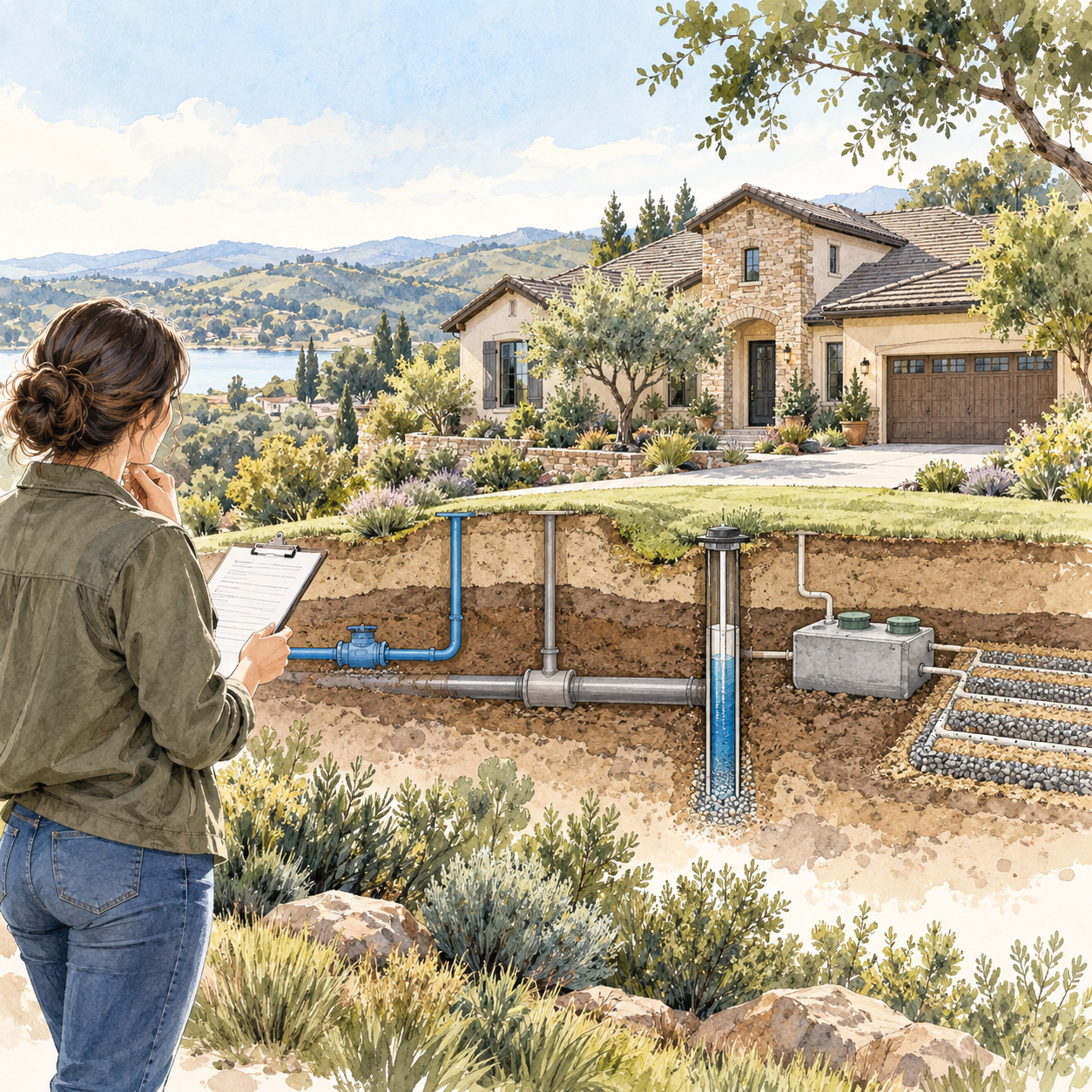
In El Dorado Hills, two attractive homes can sit minutes apart and ask different questions underground. The wastewater plan is less photogenic than the countertop, but it may matter more to inspections, costs, and remodeling ideas.
Do not fear a well or septic system. Identify what you are buying before the paperwork begins to feel like wallpaper.
Can two El Dorado Hills homes have different utility setups?
Yes. One home may have public water and public sewer, another may have public water with a septic system, and a more rural property may use both a private well and septic. Neighborhood name, ZIP code, and proximity do not prove service. Verification must be tied to the parcel and its records.
El Dorado Irrigation District, or EID, provides water and wastewater service in parts of western El Dorado County. EID says most El Dorado Hills drinking water comes from Folsom Lake, but nearby district facilities do not confirm that a home has both services.
| System question | What to verify | Useful evidence |
|---|---|---|
| Public water | Provider, meter, account status, service line | Utility bill, seller disclosure, EID confirmation |
| Public sewer | Active connection, lateral responsibility, known work | Utility record, permits, inspection or contractor findings |
| Private well | Permit, completion report, production, quality, equipment | County file, DWR well report, test results, inspection |
| Septic | Permit, design, tank and field location, maintenance, condition | County record, as-built plan, pumping history, inspection |
How should a buyer confirm public water and sewer service?
Confirm service with documents and the provider, not assumption. Review the seller's disclosures and recent utility information, then ask EID or the applicable agency to confirm the service attached to the address. If future construction is part of the plan, ask whether capacity, line extensions, or other requirements could apply.
EID advises property owners to confirm proximity to its water or wastewater facilities. A resale buyer should identify the provider, confirm the connection, understand the private lateral or service line, and investigate disclosed problems.
If you are comparing homes and want to see where seller expectations may be changing, start with Lauren's current list of price-reduced homes. A lower asking price can create room in the budget, but it does not replace utility due diligence.
What should you inspect when a home has a septic system?
Inspect the tank, distribution components, and disposal field, then compare the physical system with county records and the household's intended use. Ask about permits, design capacity, pumping and repair history, the location of the field and reserve area, and whether additions or landscaping have affected the system.
El Dorado County describes septic as onsite wastewater disposal for structures without access to a public wastewater facility. The county maintains design, permitting, and inspection standards because a failing or improperly located system can affect health, groundwater, and the usability of the property.
The county's setback guidance illustrates why the site plan matters, with separation requirements involving wells, buildings, driveways, pools, streams, and leach lines. Evaluate an existing system from its records and condition, not from a standard copied into a checklist.
Utility discoveries can change cash needs and monthly-payment comfort. Before making those tradeoffs under deadline, get pre-qualified through Lauren's approved buyer resource, then review inspection findings with the appropriate lender and licensed specialists.
What should you verify when a property uses a private well?
Verify legal records, physical condition, production, water quality, storage, treatment equipment, and the home's actual demand. A well-completion report is useful history, but it is not a guarantee of today's yield or water quality. Current testing and a qualified inspection provide different information.
El Dorado County requires permits for constructing, destroying, deepening, or repairing a well. The California Department of Water Resources also provides a Well Completion Report Map that can be searched by location. Those reports may include construction date, depth, geology, construction details, and yield recorded when the well was completed.
Ask how the home manages low-flow periods, power outages, filtration, and storage. If the property has extensive landscaping, a pool, livestock, or planned additional living space, compare those plans with realistic supply and system capacity.
Why do these systems matter after closing?
Water and wastewater systems can shape repair exposure, maintenance routines, insurance questions, and what can be built later. A pool, accessory dwelling unit, bedroom addition, expanded driveway, or major landscape plan may interact with septic capacity, leach-field location, utility easements, or water availability.
Public service is not maintenance-free, and private systems are not automatically troublesome. The useful distinction is responsibility. Buyers should know which components belong to the utility, which belong to the homeowner, and which future plans require agency review or permits.
El Dorado Hills buyer checklist
- Identify the water and wastewater provider for the exact parcel.
- Obtain recent utility information and review seller disclosures.
- Request applicable well, septic, building, and repair records.
- Locate the well, tank, disposal field, reserve area, meter, and sewer lateral.
- Use qualified inspectors and order appropriate water-quality or production tests.
- Compare system capacity with the number of bedrooms and intended household use.
- Check how a pool, ADU, addition, driveway, or landscaping plan could be affected.
- Review maintenance history, likely near-term work, and ownership responsibilities.
- Keep inspection, financing, appraisal, and insurance deadlines coordinated.
Frequently Asked Questions
Does every El Dorado Hills home use EID water and sewer?
No. EID serves many properties, but buyers should confirm water and wastewater service for the exact address rather than infer it from the neighborhood.
Is a septic system a reason not to buy a home?
No. A permitted, appropriately designed, and maintained system can serve a property well. The decision should reflect condition, capacity, records, site constraints, and future plans.
Is a well-completion report the same as a current well test?
No. The report documents the well when it was completed. A current inspection, production test, and water-quality testing address present conditions.
Can a buyer rely only on seller disclosures?
Disclosures are important, but they are one part of due diligence. Buyers should also review records, provider information, inspections, and specialist advice appropriate to the property.
My bottom line
The home above ground may win your attention, but the systems below it deserve a vote. In El Dorado Hills, identify the actual utility setup early, verify the records, inspect the components, and test your future plans against the parcel before removing contingencies.
If you are comparing El Dorado Hills homes, call me at 916-909-1411 or email lpierce@windermereca.com. I can help you build the right property-specific questions into your search and coordinate the next steps with the appropriate licensed professionals.
About Lauren Pierce
Lauren Pierce is a Realtor® with Windermere Signature Properties serving El Dorado Hills and nearby communities. She helps buyers and sellers make informed, property-specific decisions. CA DRE #02444148 | 916-909-1411 | lpierce@windermereca.com | homebuyinginnorcal.com